Posts

Showing posts with the label manipulatives

Free math apps - virtual manipulatives

Image
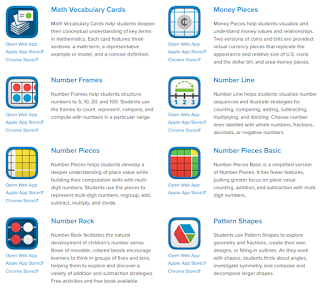
Check out this nice collection of free math apps that work as virtual manipulatives /illustrative tools for most of your elementary math. You'll find fractions, number lines (including for fractions & negative numbers), geoboard, money pieces, place value apps, number frames/number rack (for number sense/mental math), and pattern shapes. ☺

Basic abacus as a manipulative

Image
I don't want to leave out one of the best manipulatives there is for first and second graders: a simple "school" abacus that has 10 wires and 10 beads on each wire. I don't mean a Chinese or Japanese abacus with a special counting system. I am talking about using a simple 100-bead abacus for counting, and treating each bead as 1. You don't have to learn any of these sophisticated systems that have been in use with various abacuses. Just consider each bead being 1, period. Then you have 10 tens, or a hundred, in your abacus, and that goes a long way explaining tens and ones or 2-digit place value to first graders. It is best if the abacus has the first five beads colored differently from the next five, in each row, like on the right. Then the child will easily recognize 6, 7, and 8 beads without counting. Also, let's say you choose 6 beads on one wire and 8 on the next one. You can show how the five and five on those two wires makes ten, ...

Most common math manipulatives for elementary school

Image
Here are various math manipulatives that I think are most useful to have for elementary grades, found at Amazon: A 100-bead abacus (it has 10 beads on 10 rows). The abaci with 5 and 5 alternating color beads are the best, but a traditional one with 10 beads of the same color will also work. Browse Amazon's abacus collection Base ten blocks are useful for teaching the concept of place value, two-digit numbers, and three-digit numbers. Browse base ten blocks at Amazon . Another very useful manipulative is fraction tiles or fraction circles . You can make these yourself, of course, as well, from cardboard. Other necessary manipulatives are various measuring tools, usually found at home:  rulers,  measuring tape,  a bathroom scale,  kitchen scale ,  a thermometer, and measuring cups .

The value of manipulatives

(Note: I'm "resurrecting" an old post, with added information and a video. The topic is still very much valid.) Manipulatives are IN, in math education. But do they TRULY facilitate learning to such an extent as people promoting them claim? The entry at Text Savvy, Hands-on, Brains-Off , explains some of the pitfalls in manipulative use. Very enlightening! Quoting from an article at Education Week ( Studies Find That Use of Learning Toys Can Backfire ): In a similar series of experiments at the elementary-school level, the researchers found that children taught to do two-digit subtraction by the traditional written method performed just as well as children who used a commercially available set of manipulatives made up of individual blocks that could be interlocked to form units of 10. Later on, though, the children who used the toys had trouble transferring their knowledge to paper-and-pencil representations. Mr. Uttal and his colleagues also found that t...

The good side of manipulatives

Update: read also Mama Squirrel's excellent blogpost on the issue; basically there is probably a balance in this, as in everything. If you haven't, go pay a visit to the National Library of Virtual Manipulatives . Lots of good stuff there! So, why would I suddenly turn around and praise manipulatives, if I have just mentioned how they're not the "ultimate thing" in math education? It's just one of those things that can be good, if used right, in its rightful place. Manipulatives do help students to understand concepts, initially, on a concrete level. But they shouldn't stop there. Children need to learn to make generalizations. That is where the power of mathematics is. For example, maybe you might use The Base Blocks Addition to illustrate the concept of carrying to tens and hundreds (or regrouping) in addition. Once the student understands that, they should be able to translate their knowledge into bigger and smaller place values (includ...

Know Your Tools

Image
Math teacher's tools are quite numerous nowadays. First of all of course comes a black or white board, or paper - something to write on, pencil, compass, protractor, ruler, eraser. And the book you're using. Then we also have computer software, animations and activities online, animated lessons and such. There are workbooks, fun books, worktexts, online texts. Then all the manipulatives, abacus, measuring cups, scales, algebra tiles, and so on. And then there are games, games, games. The choices are so numerous it's daunting. What's a teacher to do? Well, you just have to get started somewhere, probably with the basics, and then add to your "toolbox" little by little as you have opportunity. There is no need to try 'hog' it all at once. It's important to learn how to use any tool you might acquire. Quantity won't equal quality. Knowing a few "math tools" inside out is more beneficial than a mindless dashing to find the newest activi...